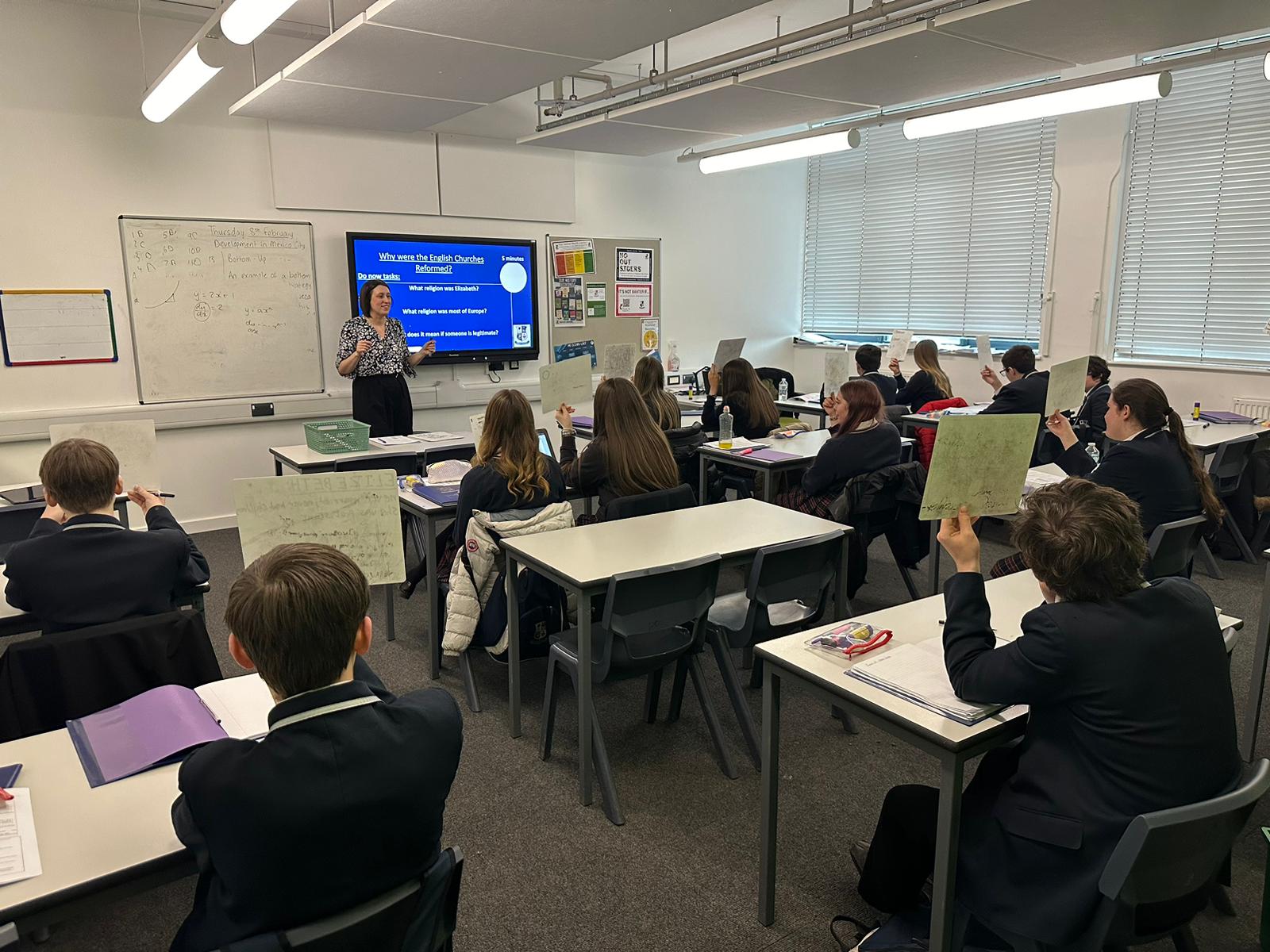
Why study history?
History is a ‘gold standard’ academic subject, consistently cited by top universities as one of the most challenging and worthwhile subjects to study at school.
History increases students’ knowledge and understanding of key events in the past. History also helps students to rapidly improve their writing skills and their ability to organise and structure their thinking. They use a variety of sources of evidence, and learn to weigh up evidence and reach sensible conclusions. Above all, they learn to explain clearly and fully, and to analyse — linking ideas together, examining similarities and differences and exploring continuity and change over time.
The history curriculum aims to inform students about the past, and particularly about ‘the story of these islands’. We want students to understand who we are as a nation and how we got here.
Mrs Gresham
History in key stage 3
| Year 7 Content |
Term |
| How do historians uncover the past? |
Autumn 1 |
| Did the Normans bring “a truck-load of trouble”? |
Autumn 2 |
| Who had power in later medieval England? |
Spring 1 |
| What can we learn from Mansa Musa about medieval Mali? |
Spring 2 |
| What impact did the Reformation have on England? |
Summer 1 |
| Was the 17th century “a world turned upside down”? |
Summer 2 |
| Year 8 Content |
Term |
| India and the British Empire |
Autumn 1 |
| What was Britain’s role in the transatlantic slave trade? |
Autumn 2 |
| How significant were Emma Griffin’s findings on the Industrial Revolution? |
Spring 1 |
| How democratic was Britain by 1900? |
Spring 2 |
| Why was the First World War known as “the war to end all wars”? |
Summer |
| Year 9 Content |
Term |
| Do we agree with Fern Riddell’s interpretation of the suffragettes? |
Autumn 1 |
| Was the Second World War Hitler’s war? |
Autumn and Spring |
| Why is the Holocaust so significant? |
Spring and Summer |
| Liverpool in the Swinging Sixties |
Summer |
History in key stage 4
Examination Board: Eduqas
Specification Name: History
Link: History
The GCSE course covers:
- The USA: A Nation of Contrasts 1910–1929
- The Development of Germany 1919–1991
- Elizabethan England 1558–1603
- Changes in Health and Medicine in Britain c500 to the present day
| Year 10 USA 1910–1929 Content |
Term |
| Theme 1 Immigration |
Autumn |
| Theme 2 Religion and race |
Autumn |
| Theme 3 Crime and corruption |
Autumn |
| Theme 4 The role of women |
Autumn |
| Theme 5 Entertainment |
Autumn |
| Theme 6 Economic boom |
Spring |
| Theme 7 End of prosperity |
Spring |
| Year 10 Germany 1919–1991 Content |
Term |
| Theme 1 Weimar Germany |
Spring |
| Theme 2 Rise of the Nazis |
Spring |
| Theme 3 Life under the Nazis |
Spring |
| Theme 4 Life during the Second World War |
Summer |
| Theme 5 A divided Germany |
Summer |
| Theme 6 The Cold War |
Summer |
| Theme 7 Cooperation and reunification |
Summer |
| Year 11 Elizabethan Age 1558–1603 Content |
Term |
| Theme 1 Elizabethan government |
Autumn |
| Theme 2 Lifestyles of the rich and poor |
Autumn |
| Theme 3 Elizabethan entertainment |
Autumn |
| Theme 4 The problem of religion |
Autumn |
| Theme 5 The Catholic threat |
Autumn |
| Theme 6 The Spanish Armada |
Autumn |
| Theme 7 The Puritan threat |
Autumn |
| Year 11 Medicine c500 to the Present Day Content |
Term |
| Theme 1 Causes of disease and illness |
Spring |
| Theme 2 Attempts to treat disease and illness |
Spring |
| Theme 3 Attempts to treat and cure disease and illness |
Spring |
| Theme 4 Advances in medical knowledge |
Spring |
| Theme 5 Developments in patient care |
Spring |
| Theme 6 Developments in public health |
Spring |
Exemplar learning programmes
More information
*This article featured in the February 2024 issue of Ridgeway New Times. Some of the curriculum information may not be up to date.